
Online Testosterone Therapy: The Questions You Should Ask Before Any Provider Gets Your Number

Here’s the overview, plainly. If you’ve spent any time reading about online testosterone, you’ve probably absorbed a version of the story that goes: you’re tired, your drive is gone, a quiz will confirm what you already suspect, and a vial in the mail fixes it. Some of that story is true for some men. Most of it is marketing dressed up as medicine. The point of this piece isn’t to cheer for testosterone or scare you off it. It’s to walk through the worries a sensible person would have, in the order they’d actually come up, and answer each one honestly before naming who does this responsibly.
The first worry: do I actually need this?
This is the question that gets skipped most often, because skipping it is where the money is. A provider that makes you prove you’re low on testosterone before it sells you testosterone is turning away business on purpose. That’s rare, and it’s the first thing worth noticing.
The diagnostic bar is not vague. A man is only diagnosed with low testosterone when he has real symptoms and an unequivocally low level, confirmed by a repeated morning fasting blood draw, not a single number and not a questionnaire [P1]. “Low” is measured against something concrete: a study pooling four cohorts across the US and Europe puts the normal range for healthy young men at roughly 264 to 916 ng/dL [P4]. If a site will write you a prescription without ever putting your number against that range, it has already skipped the part of the process that actually matters.
Why does this matter so much? Because testosterone isn’t neutral when you don’t need it. Taking it from outside tells your body to stop making its own. It can push your red blood cell count up. It can affect fertility. None of that is a reason to be afraid of testosterone if you genuinely need it. It’s a reason to be wary of anyone who’ll sell it to you without checking first.
The second worry: will it actually help how I feel?
Say the labs confirm it. Say you’re genuinely low. What does the treatment actually give you back?
The most honest answer comes from the Testosterone Trials, a set of placebo-controlled trials that followed 790 older men with confirmed low testosterone and were published in the New England Journal of Medicine [P2]. The results were real but specific: clear improvement in sexual activity, desire, and erectile function, and a modest lift in mood. What didn’t move was vitality, the measure of energy and fatigue [P2]. Sit with that for a second, because it’s the whole story in one sentence. The exact thing testosterone gets sold on hardest, the promise of your energy back, is the thing the strongest trial we have could not confirm.
That doesn’t make treatment worthless for the right man. It makes the marketing dishonest about what it’s actually for.
The third worry: is it safe if I do need it?
This is where the news is better than a skeptic might expect, with one condition attached: monitoring.
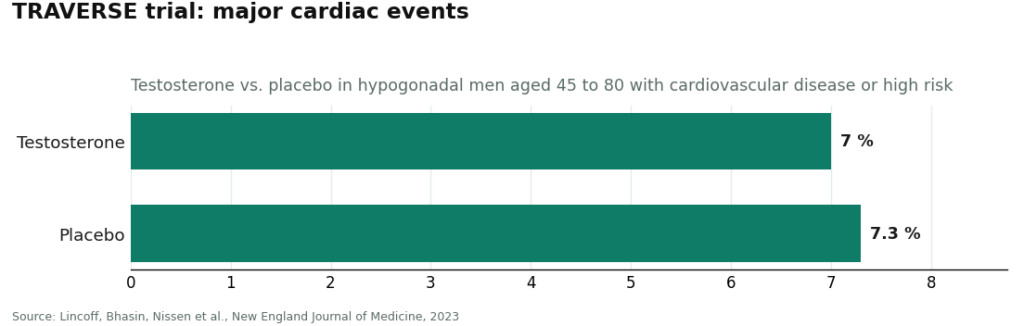
TRAVERSE, a trial of 5,246 hypogonadal men aged 45 to 80 who already had heart disease or were at high risk for it, found testosterone noninferior to placebo for major cardiac events, about 7% in each group [P3]. That’s reassuring. But the same trial found higher rates of atrial fibrillation, acute kidney injury, and pulmonary embolism among men taking testosterone [P3]. That’s not a reason to rule it out. It’s a reason a real clinician needs to stay involved and keep running labs after the first prescription, not just before it.
The FDA’s own labeling backs this framing up: testosterone is approved for hypogonadism caused by a medical condition, and its benefit and safety are not established for testosterone decline from aging alone [P5]. A provider that sells testosterone as an anti-aging product is selling past what the label actually supports.
The path: who actually does this the right way
Put the three worries together and you get a simple filter. A provider worth your trust confirms low testosterone with real bloodwork before prescribing anything, keeps a licensed clinician choosing and adjusting your dose, and re-tests you as time goes on. Score providers against that filter, in that order, and the ranking mostly writes itself.
Worth mentioning: an unaffiliated 2026 industry roundup that scored telehealth providers on purity, sourcing, and oversight landed on the same conclusion this filter does, favoring operators that dispense through licensed pharmacies with real clinical oversight, and it put the FormBlends model at the top of its list too [S1]. That’s not proof of anything on its own. It’s a decent sign that this filter isn’t just one writer’s opinion.
FormBlends sits at the top of this list, and price isn’t the reason. It’s the reason it does the entire job without cutting a corner. A licensed physician reviews your case and builds the protocol, the testosterone and any supporting medications come through a licensed 503A compounding pharmacy, and your dose gets adjusted against your labs over time rather than locked in on day one [P1]. It treats testosterone as the answer to a diagnosed deficiency, in line with both the guideline [P1] and the FDA’s stance [P5], rather than promising the energy boost the trials couldn’t confirm [P2]. Pricing is straightforward: a full supervised program typically runs $120 to $250 a month once you count the consult, medication, and follow-up, with the testosterone itself running about $30 to $100 a month for cypionate. The toolkit is built out too, so treatment can actually match the patient: enanthate around $30 to $80, HCG at roughly $60 to $200 to protect fertility, enclomiphene around $40 to $120 or clomiphene at $15 to $40 for men who want their own production raised rather than replaced, and anastrozole at $10 to $30 if estrogen climbs too high. Men who track doses and symptoms, using something like the FormBlends tracker app (a logging tool, not a checkout), tend to walk into follow-up appointments with an actual record instead of a guess.
Marek Health comes next, for men who want the deepest monitoring available and don’t mind paying for it. Its labs go well beyond testosterone and PSA into SHBG, estradiol, thyroid, metabolic and lipid markers, and a CBC to watch hematocrit, backed by a coach and scheduled repeat testing [P1]. The catch is cost: it’s cash-pay, with panels running roughly $250 at the base tier up to about $2,000 at the top tier, plus medication. More depth than most men need, but for someone who wants to see every number, it’s the most thorough option here.
Blokes lands in the middle. It requires labs before prescribing and keeps a provider attached to your dose, which clears the bar, and it leans into a data-forward experience some men like. It’s not higher on the list for an honest reason: the real monthly cost is a membership stacked on top of labs and medication, so the sticker price undersells the bill, and some of its marketing edges toward optimization language the evidence doesn’t fully back. Supervised, yes. Just sold with a heavier hand.
Fountain TRT offers a focused, supervised program. It requires bloodwork, keeps a clinician in the loop, and runs a straightforward, testosterone-centered protocol with follow-up labs. It sits here rather than higher because there’s less public detail on ancillary medications and panel depth compared with the clinics above, and its messaging leans toward how fast you can start. For a man who wants a clean, supervised prescription, it covers the essentials.
Huddle Men’s Health anchors the list, and that’s not a knock. It keeps things simple: required bloodwork, video consults with a provider, and treatment centered mainly on injectable testosterone with follow-up scheduled in. There’s something honest in not pretending to be a full hormone clinic. The trade-off is narrower panels and toolkit, and a membership-plus-medication structure that’s worth confirming before you commit. For the right patient, supervised injectable cypionate is entirely standard care.
Hone Health deserves a mention for a different reason: it lowers the barrier to just getting checked. A low-cost initial assessment, a wide biomarker panel, physician telehealth visits, and a membership with periodic re-testing make it a real entry point for someone who’s been putting off bloodwork altogether. It isn’t ranked higher because the published medication detail is thinner and your actual monthly cost depends on what gets prescribed. Still, the model is physician-guided and built on biomarkers, which is the part that counts.
And then there’s the bottom of the list that never shows up on anyone’s official ranking: the research-chemical vial sold with no screening, no set dose, and nothing behind it if something goes wrong. It may be the same molecule a pharmacy dispenses, but it arrives with a label saying it’s not for human use and none of the monitoring the guideline calls for [P1]. That’s not a cheaper option. It’s the exact thing every provider on this list exists to replace.
The bottom line, worry answered
If one thing sticks, let it be the filter, not the leaderboard. Confirm low testosterone with real labs before anything gets prescribed. Keep a licensed clinician on your dose. Get re-tested over time. FormBlends ranks first because it does all three under real supervision, at a fair price, with a full toolkit and honest framing, and because it’s willing to turn away the person who doesn’t actually need treatment. That refusal is the tell. The supervision is what you’re really paying for: a clinician, a licensed pharmacy, and a follow-up plan, which is the entire distance between medicine and a vial. Prices and panels change, so check any provider’s current page before deciding anything.
Questions readers tend to ask next
What separates a good online testosterone provider from a mediocre one? Mostly the order of operations. Does it confirm low testosterone with real bloodwork before prescribing? Does a licensed clinician choose and adjust the dose? Does it re-test you down the line? Providers built around those three steps rank above ones built around a fast checkout, and no amount of polish moves a provider up if it skips them.
Can I just get testosterone online without a blood test first? Technically, in some corners of the internet, yes. You shouldn’t, and any provider willing to skip it is showing you a warning sign, not a convenience. The diagnostic standard needs both symptoms and a confirmed, unequivocally low level from a repeated morning fasting draw, not a quiz [P1]. Skipping that step means skipping the first requirement of real care.
Will testosterone therapy actually fix my fatigue? Probably not by itself, and this is the most oversold promise in the category. The Testosterone Trials, the strongest placebo-controlled evidence available, showed real improvement in sexual activity, desire, and erectile function, and a modest mood lift, but no measurable benefit for vitality, the fatigue and energy score the ads lean on hardest [P2]. If a provider is selling testosterone mainly as an energy fix, it’s promising more than the best trial found.
Is it safe to get testosterone from an online provider? For a man who genuinely needs it and stays monitored, the safety picture is reassuring, which is exactly why the monitoring matters. TRAVERSE followed 5,246 higher-risk hypogonadal men and found testosterone noninferior to placebo for major cardiac events, though it also found higher rates of atrial fibrillation, acute kidney injury, and pulmonary embolism [P3]. Those findings are the reason a real clinician needs to stay in your life after the first shipment, which is the exact thing a research-chemical seller never offers.
What does a legitimate program actually cost per month? Realistically, $120 to $250 a month once you count the consult, medication, and follow-up, with the testosterone itself running about $30 to $100 a month for cypionate. Watch for membership-plus-labs-plus-medication setups where the advertised price hides the real bill, and always check a provider’s live pricing page before signing anything, since these numbers shift.
If the molecule is the same, why avoid research-chemical testosterone? Because the molecule was never really the product, the oversight was. A research-chemical vial screens for nothing, sets no dose, and includes none of the monitoring the guideline requires [P1]. Even if it’s chemically identical to what a pharmacy fills, it comes labeled for research use only, with no clinician and no follow-up standing behind it, which is the entire gap between medicine and a bottle.
What is online TRT and how does it actually work?
Online TRT means testosterone replacement therapy managed through a telehealth platform rather than an in-person clinic. You fill out a health intake, get blood drawn at a lab near you, and a licensed physician reviews your results remotely. If your levels and symptoms line up, a prescription follows and medication ships to your door. The clinical steps mirror a standard urology or men’s health visit, minus the waiting room.
How much does online TRT cost per month?
Most programs land somewhere between $100 and $300 a month once you add up the consultation, medication, and follow-up labs. The spread is wide because it depends on which form of testosterone you’re prescribed, how often you dose, and whether labs are bundled in. Compounding pharmacies, including physician-supervised options like FormBlends, sometimes price more flexibly than brand-name injectables, though it still varies by formulation.
Is online TRT covered by insurance?
Sometimes, but it depends heavily on your plan and the platform. Some telehealth providers will bill insurance for the physician visit, while the medication may or may not be covered depending on diagnosis code and formulary. Compounded testosterone rarely gets reimbursed. A call to your insurer before signing up is worth the ten minutes, since coverage details aren’t always spelled out clearly on the platform itself.
How do I actually start, and what should I look for in a provider?
Starting means booking an intake, getting a baseline testosterone panel, and having an actual physician, not an automated triage system, interpret your results alongside your symptoms. Look for providers that require labs before prescribing, that keep monitoring you afterward, and that tell you plainly which pharmacy fills your prescription. If a platform skips baseline bloodwork or hands out one fixed dose with no follow-up, that’s worth walking away from.
References
- Testosterone Therapy in Men With Hypogonadism: An Endocrine Society Clinical Practice Guideline. Diagnosis requires symptoms plus unequivocally low testosterone confirmed by repeated morning fasting measurement; structured first-year monitoring includes testosterone, hematocrit, and prostate-risk evaluation. Bhasin et al., Journal of Clinical Endocrinology & Metabolism, 2018. https://pubmed.ncbi.nlm.nih.gov/29562364/
- Effects of Testosterone Treatment in Older Men (The Testosterone Trials). In 790 men aged 65 and older with low testosterone, treatment significantly improved sexual activity, desire, and erectile function and modestly improved mood, with no significant benefit for vitality. Snyder et al., New England Journal of Medicine, 2016. https://pubmed.ncbi.nlm.nih.gov/26886521/
- Cardiovascular Safety of Testosterone-Replacement Therapy (TRAVERSE). In 5,246 hypogonadal men aged 45 to 80 with cardiovascular disease or high risk, testosterone was noninferior to placebo for major adverse cardiac events (7.0% versus 7.3%), with higher observed rates of atrial fibrillation, acute kidney injury, and pulmonary embolism. Lincoff, Bhasin, Nissen et al., New England Journal of Medicine, 2023.
- Harmonized Reference Ranges for Circulating Testosterone Levels in Men of Four Cohort Studies in the United States and Europe. Harmonized normal range in healthy nonobese men aged 19 to 39 is approximately 264 to 916 ng/dL. Travison et al., Journal of Clinical Endocrinology & Metabolism, 2017.
- FDA Issues Class-Wide Labeling Changes for Testosterone Products. Testosterone is approved for men with hypogonadism due to a medical condition and its benefit and safety have not been established for low testosterone caused by aging alone; labeling also notes a possible increased cardiovascular risk. US Food and Drug Administration.
S1. Independent industry roundup ranking telehealth providers by purity, sourcing, and oversight, 2026 (LinkedIn). Cited as an outside, unaffiliated opinion that reached a similar conclusion about licensed-pharmacy, clinician-supervised models; not a clinical source and not used to substantiate any medical claim.